To be able to talk about a field, one should be fluent with the terms used in the very field. Or as Antoine de Saint-Exupéry put it in The Little Prince:
Words are the source of misunderstandings.
Recently, in our MA programme, we have been introduced into the terminology of the e-learning and distance learning field. I had heard most of those terms before, but I never knew what concepts were implied by several of them.
Another notion I had was that they altogether sounded somehow welcoming. This possibly was a side effect of the friendly and positive adjectives those terms use, e.g., open, flexible, responsive, adaptive, personalised etc. They seem to clearly distance themselves from any impediments or constraints put on the learner or the learning process. This resonates with me. From my experience, (my) learning works best whenever I have the chance to learn without being forced to learn.
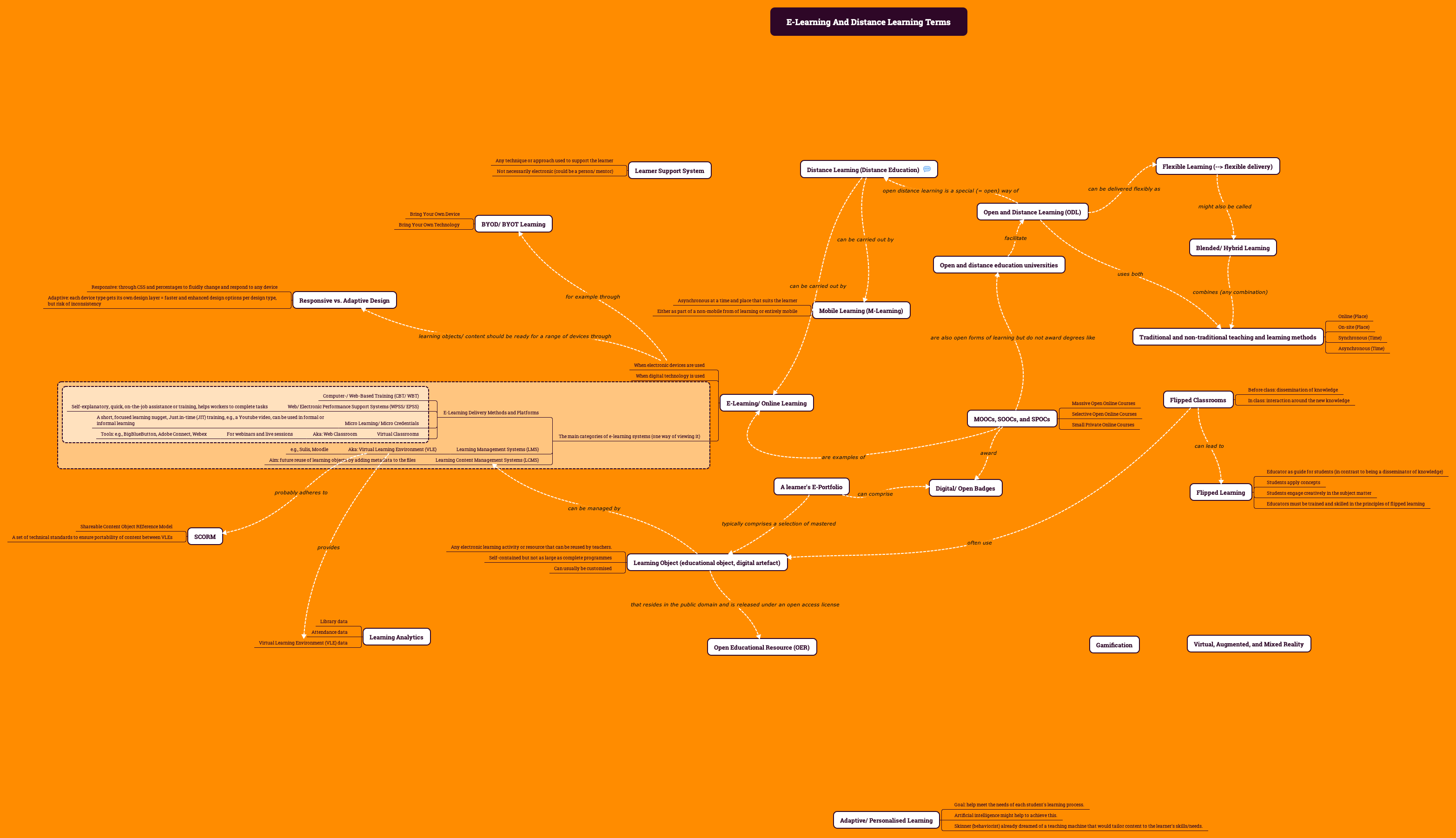
So, I took the chance to learn the new and friendly e-learning terms by doing something I like to do: drawing a concept map.
- As I wanted to share the map online, I confronted myself with a digital tool rather than pen and paper, and I tried out XMind for the drawing. (I might write a tool review about XMind on another occasion.)
- As the learning process was the important part of the drawing activity, I did not strictly adhere to concept map rules but rather drew a mixture of concept map and mind map. (I might write a concept-map-vs-mind-map article on another occasion.)
Find my e-learning terminology map below and feel free to share it, reuse it, and/ or comment on it.
Note: Click here to enlarge the preview image shown below.
 API docs and me